Over 95% of the reviews and essays on NYGameCritics.com are created by our paid student interns and young mentors who have taken our classes. Donations help support our incredible student writers.
New York Game Awards and GG! Fest tickets are now available! Get them before they sell out!
By Ronald Gordon
This article marks part two of Ronald Gordon’s series of interviews conducted at Game-A-Palooza, which took place in Brooklyn.
Interview: ty & moochi from Pondlife
As a game with an absurdly adorable character, I couldn’t help but be drawn into pondlife: discone (a videogame). Its long title isn’t what stuck with me, but the unorthodox tranquility I experienced from the game definitely did. In talking with the pair of devs, who go by ty and moochi, I got to understand just what discone was meant to be, and why I wound up feeling so tranquil by the end of my experience.
Ronald: Where does the inspiration come from?
ty: We have a lot of inspirations. I’ll say one for me personally was Mario 64, when you first start the game and you’re in Peach’s courtyard, the castle grounds, and you can just jump around freely, there’s no levels to jump through, no obstacles, you’re just in this little playground to play in. I think both of us wanted to make a game that has that feeling but for the whole game. Just a big open playground for you to explore and jump to your heart’s delight.
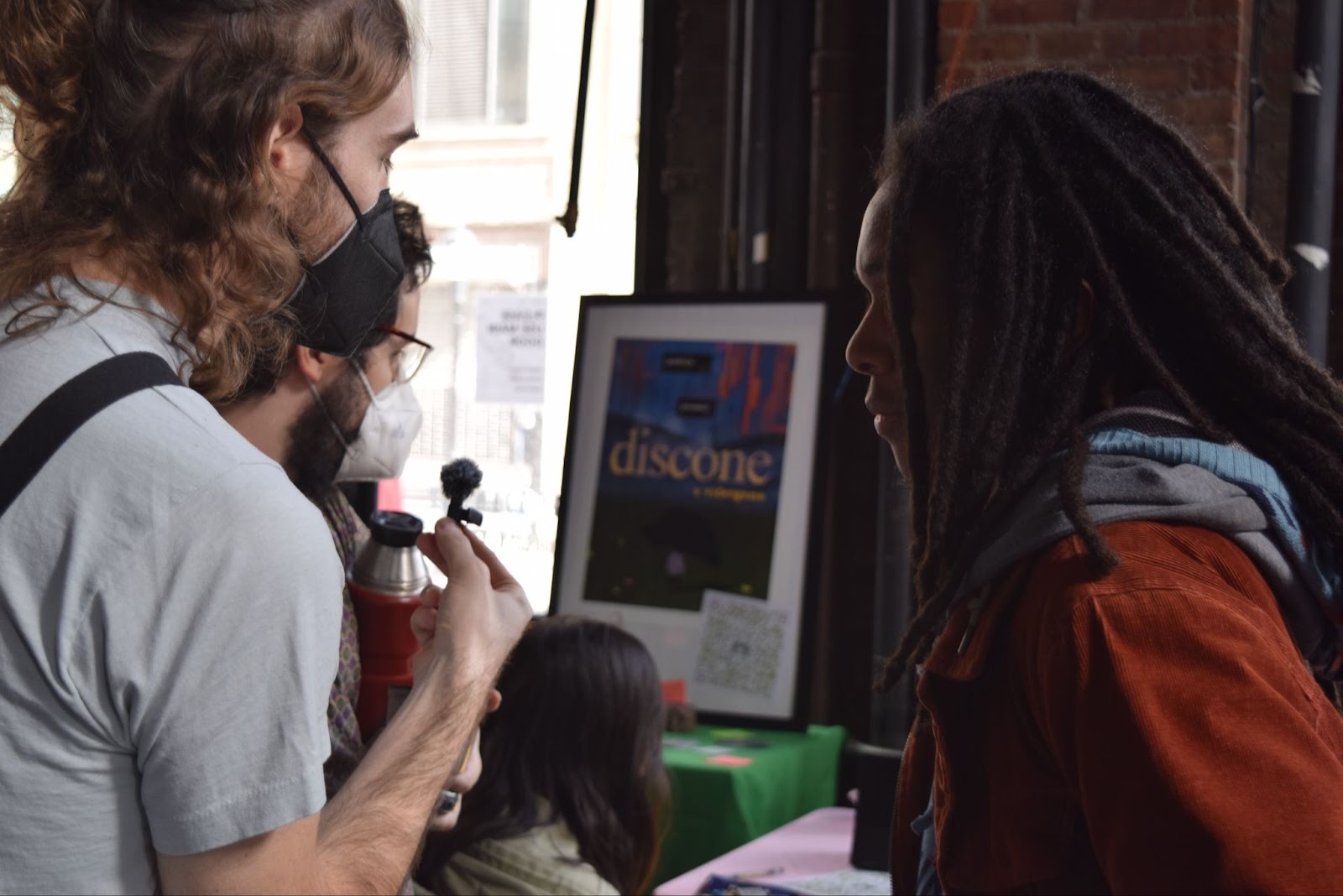
Ronald: What feelings are you hoping to invoke in players? Is this meant to be a tranquil/serene game?
moochi: Yea! You asked about inspiration early on, we’re really inspired by games that are traditionally or usually thought of as hard games or rage games, but we like them and we don’t play them in this rage way. Getting Over It is a great example, a game I love and a game that I think that after a while isn’t stressful anymore. It’s kind of relaxing and I think that’s the point of the game. There were times where we thought “How can we evoke that feeling without skipping the stress?” (But we also wanted to) allow the player to choose and say “I want to challenge myself” and navigate that on their own. A lot of the aesthetic has been about managing that. We want to make a rage game. But it’s not rage.
Ronald: How have these events helped you as a developer(s)?
ty: We haven’t gone to a ton of events, but I think it’s really helpful just to see/gauge progress. We’ve gone to a few events at very different parts in our development cycle, and we haven’t gone to one in a while. We’ve done a ton of work on the tutorial of the game, and these are the best spots to see how many people are getting it. After many years of people not getting it, or coming to events and seeing some people struggle to learn how to play on their own, I feel like we’ve done something this time. I think it’s a really good way to get a bunch of feedback all at once, and also see your own progress, and get a chance to see people have fun.
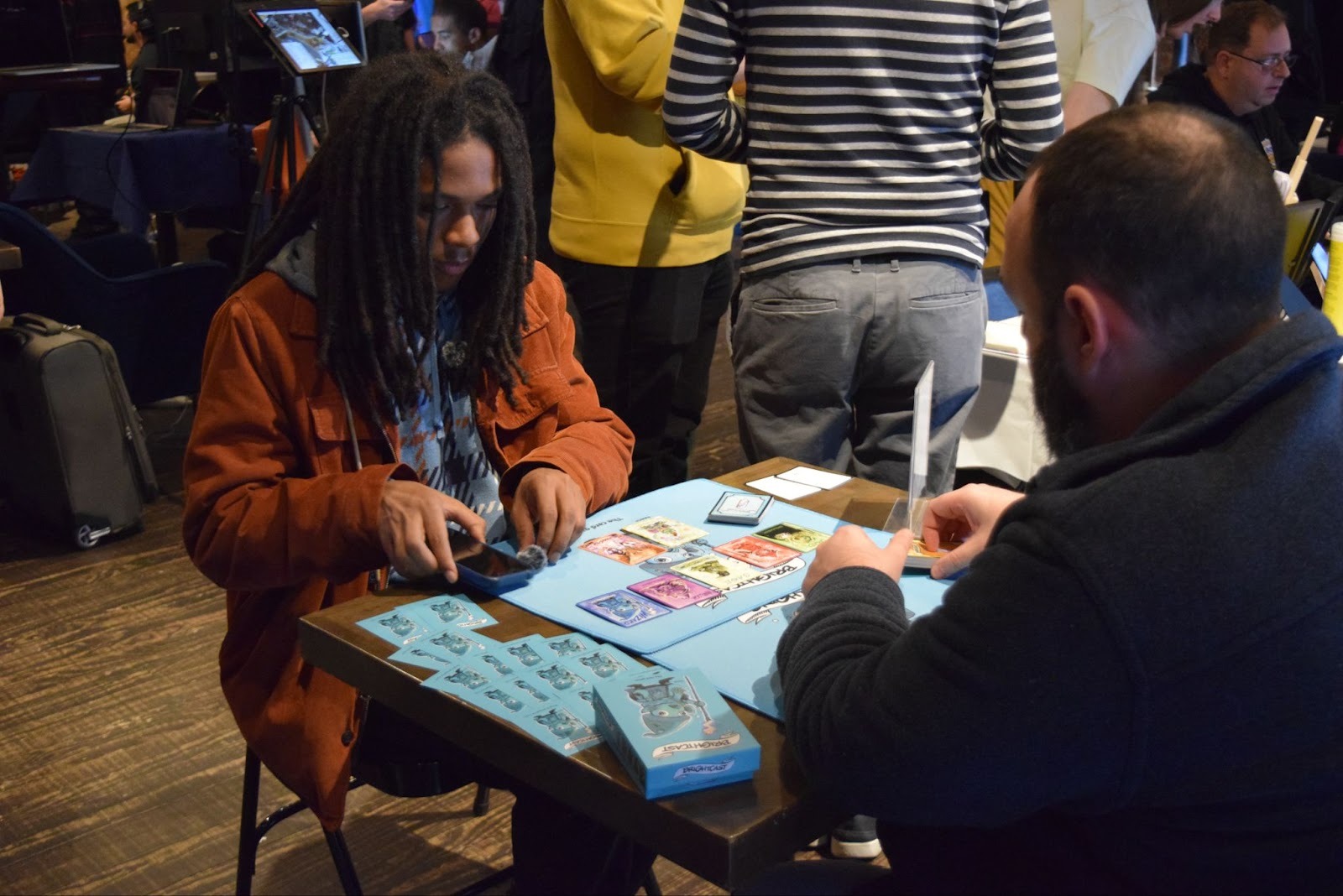
Hugh from Brightcast Games
It’s not often that I go out of my way to sit and play a competitive card game against someone, but the colorful characters within Brightcast pulled me right into the seat. Across from me was one of its co-designers. Hugh introduced me to the game in such a welcoming way I didn’t even mind that I lost to him in the end. Here’s what I took away from our conversation
Ronald: What’s your name and what’s your game?
Hugh: My name is Hugh, this is my game Brightcast. My partner and co-designer is named Nick Forker. He also did the artwork. We met playing games almost 20 years ago now and we have a passion for Tabletop games specifically and this is something we’ve been wanting to put together for a long time. This is our brain child.
Ronald: How has it been being an indie dev as a small team?
Hugh: I think it’s great. My personality and Nick’s personality, we’re both very fiercely independent and we really enjoy working for ourselves. We’re both very much creatives and even more so artistically, so just the freedom of being able to make all the decisions and living with those decisions even if they’re good or bad has been really rewarding. I think you tend to work harder and push even more when it’s your brain child, your baby. You want to bring it into the world and put out there.
Ronald: How have these events helped you as a developer?
Hugh: I think Connections are what I’ve learned to be the most important thing. Tabletop games are about making connections by virtue of playing with people, and I think you can kind of extrapolate that to the broader community as a whole. I love meeting other designers, seeing their games, and learning from them. There’s so many aspects of other games that people think of that I’ll often go, “Why didn’t I think of that? It’s so simple, it’s so clear!” I hope that people can take that away from us as well. I would say that the connection is what I find to be really helpful because we want to expand our game as well, and that sense of community.
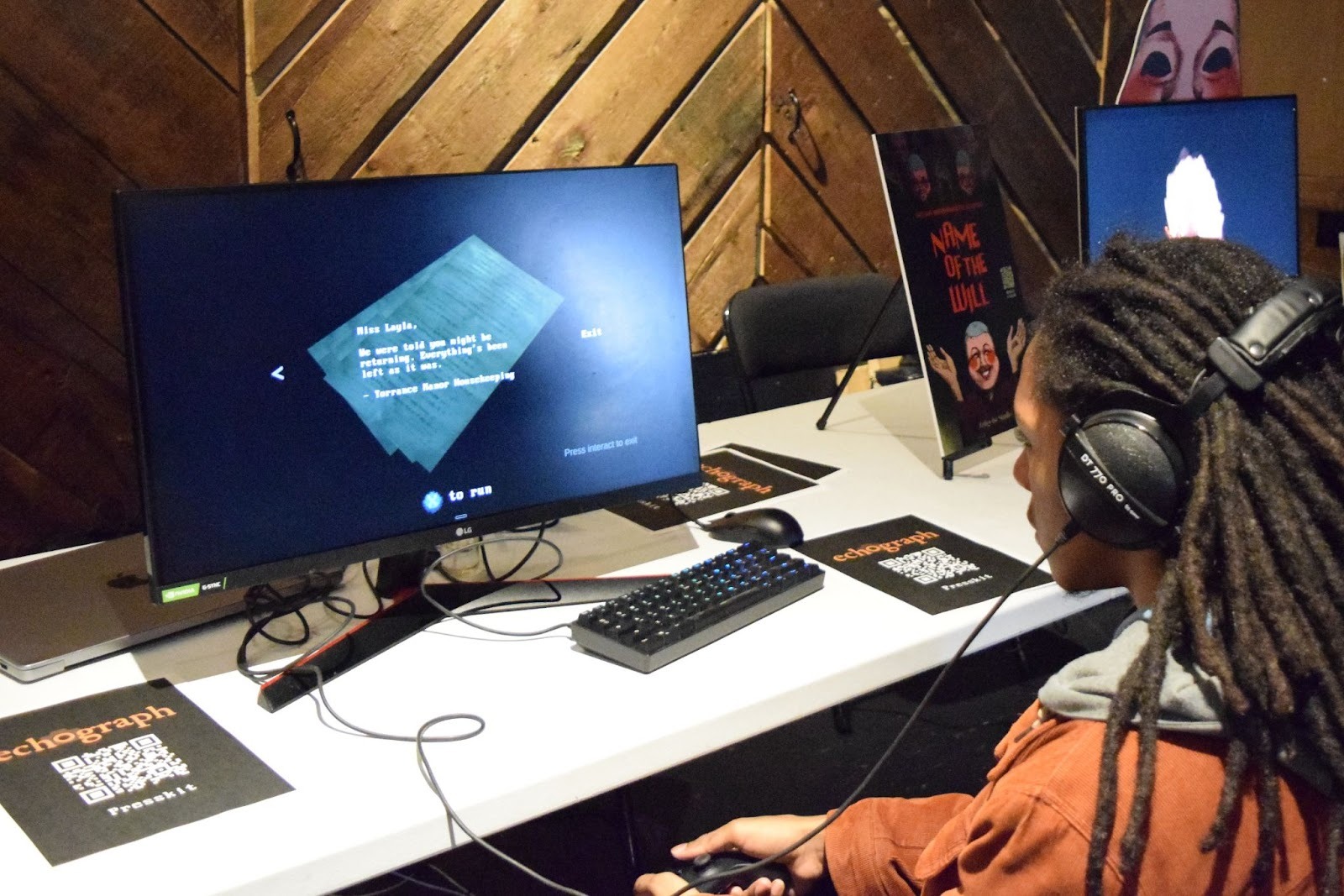
Sach from Pappy’s Pipe Dream
When coming across Echograph, seeing its camera controls akin to Fatal Frame or Dreadout. So I couldn’t stop myself from jumping right into the demo. Sach, the developer, sat next to me as I played, answering small questions about hitboxes as I bull-headedly tried to kill the first enemy I saw. In the end, here’s what I took away from our chat.
Ronald: I’m noticing some Resident Evil/Fatal Frame aspects. Where do your inspirations come from?
Sach: I think those two are pretty accurate. Those are the super obvious ones on the gameplay side. Story side, if you’ve ever watched the movie Hereditary, that’s’ an inspiration. For me, that idea of generational trauma speaks a lot to me personally, and having the main character Layla discover what has happened to her family and what was happening when she was a child in that home she grew up in, is a big part of the inspiration for the story.
Ronald: How has it been being a solo dev?
Sach: I do things in sections. I cannot do both marketing the game, and working on the game at the same time. I think that is a big downside. But then I also get to implement all the ideas I possibly have in my head that I don’t have to run by a team, so there’s pros and cons. I do have someone helping out on the music side. That’s the one area I’m not very good at. Together, we still have some amount of back and forth, but honestly speaking, these days solo dev is very feasible for many people. It just requires a lot of effort.
Ronald: How have these events helped you as a developer?
Sach: Today, I think it is a huge deal for me. Today is the first day I’ve shown my game at an actual event, and so the game was only announced two weeks ago. What you play is a pre-alpha build, so it’s still getting there. But I think these types of events, playtesting nights that Gumbo hosts, all this stuff together really helped me polish what I’m building and get the reps in. I understand what people like about my game and what they don’t
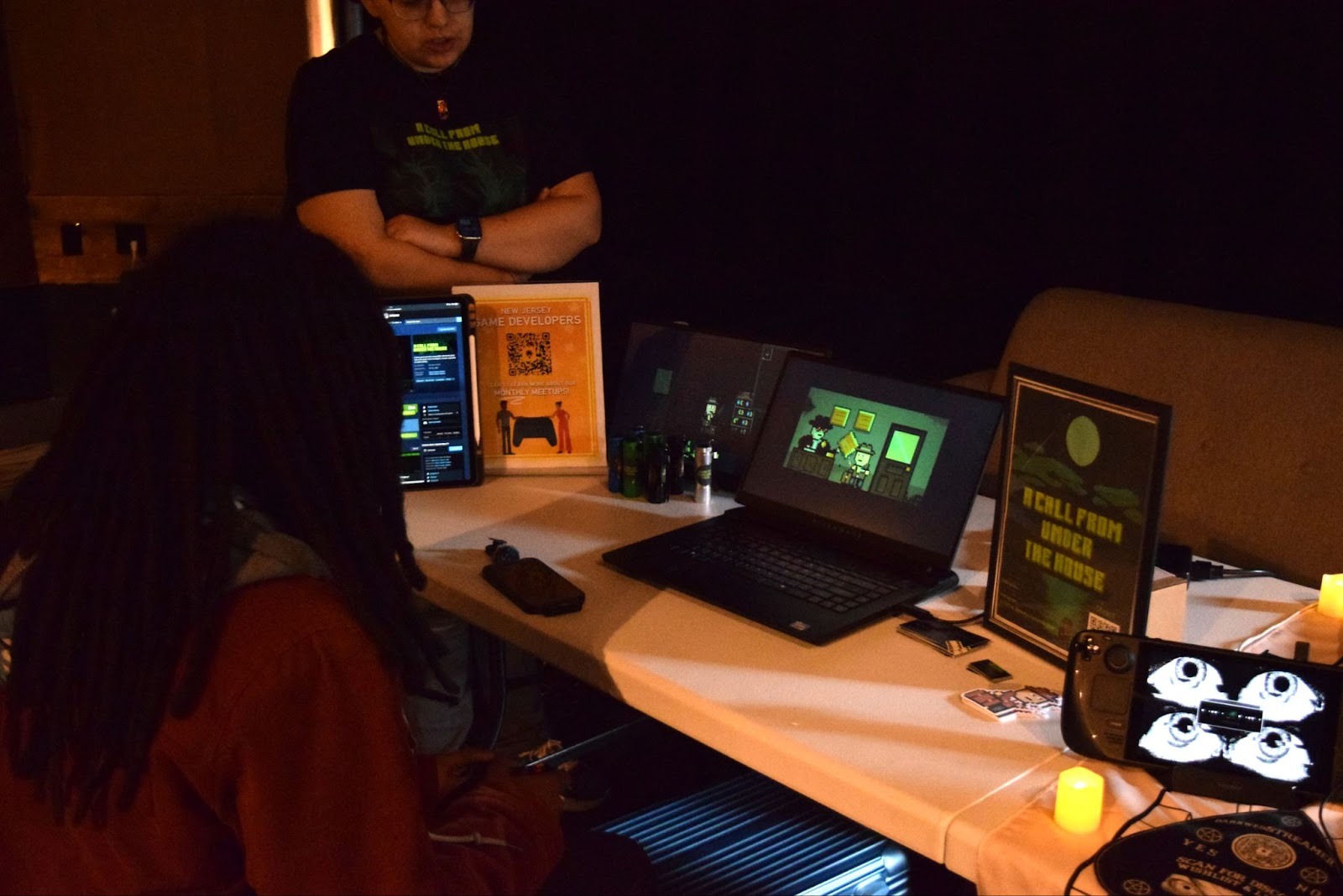
Alex from Party Crasher Games
One games I just had to try is a pixelated title called A Call from Under the House. The moment I began playing, I realized how much of a trap this game was for someone like me. Not only was it engaging with its various puzzles, but it allowed me to mindlessly grab and collect every item that wasn’t nailed down, which is a habit in every game I play. I had a chat with one of two devs of Party Crasher Games. Here’s the more important part of our talk.
Ronald: Are you a fan of Cthulhu?
Alex PCG: A little bit. My co-dev is much more. A lot of the Eldritch Horror inspiration comes from him – he’s the artist. But I like the cosmic unknown elements of that and I like the weird jarring things happening. A lot of the game is – you click on something and you’re transported somewhere else, and it’s a lot of bouncing around.
Ronald: How has that experience been, being two indie devs?
Alex PCG: It has its ups and downs. On the bright side, it’s very easy to communicate and make decisions and work quickly. On the downside, it’s a lot of work for both of us. Before this we were full time students so we couldn’t work on the game as much. Now, we’ve been able to ramp up production and also events like this. But he couldn’t make it, so I’m all by myself. The downside of not having a big team is not having the manpower. But I love working with Harry, he’s a really talented pixel artist, and we make a great team.
Ronald: Do you feel events like this are beneficial to you?
Alex PCG: Yea, definitely! As a small team, I have really no marketing. We have our socials but it’s the two of us running the accounts on top of working on the game. So this is a great way for us to get the word out about and get people actually playing it and it’s probably where we get most of our wishlists and all of that so it’s great exposure.
Yajaira Evans, My Photographer for this event
It’s not often I’m able to bring a helping hand to events like this. But this time I was fortunate enough to have space for my partner to tag along. She’s an ace with a camera, and with this being one of the only times she’s able to make it to an event with me, I couldn’t pass up the chance to get her thoughts on how Game-A-Palooza felt from an outsider’s perspective. These are her thoughts:
Ronald: Since you don’t make it to events like this often, how do you feel about Game-A-Palooza?
Yajaira: It was interesting seeing a bunch of small-time developers have a place where they can show off their games and use it as a great way to improve and see what others have that could inspire them.
Ronald: Does this kind of event, being NYC-based, make it accessible to you?
Yajaira: It does. You tend to see a lot of events like Comic-Con and other bigger events but they’re always in other states or you need to plan ahead if you want to actually go. Knowing that there’s one closer by, that doesn’t need much prep, is good.
Ronald: How do you feel about NYC having more of these events, Game-A-Palooza, NYC Games Festival, etc?
Yajaira: It’s good, New York doesn’t have quite a lot to check out. Once you’ve seen something once, it kind of loses interest. Events like this are a good addition, and it’s a great way for people who enjoy gaming to come and check things out without having to go far or spend a lot. I’d probably come to events like this more often, I am one who enjoys gaming and I’ve always wanted to make games. Seeing something like this is great motivation.
As many interviews as I got, there were a few developers I never managed to grab. One such dev, Pariah Interactive inc, created a surreal platformer following the lives of various main characters throughout multiple stages. While I was eager to get creative insights into 1000 Deaths, the developer was constantly swamped with conversations, and I never really got the chance to pull them aside. Still, it looks like a great game!
Ronald Gordon is a New York Videogame Critics Circle Member and Mentor. He was the first of our writers – or any intern anywhere – to complete an internship at Rockstar Games.


