All week long, Kim is covering GDC for the Circle. This is Part Four of her coverage there. All included photos are by Kimari Rennis.
By Kimari Rennis
Day 3 – Mar 20
9:00 AM PST

As a game designer and a vehement fan of Horizon Zero Dawn and Forbidden West, it was my duty to attend the Relic Ruin Puzzle Design talk held by one of Guerrilla Games’ senior game designers, Daniel Wewerinke.
The event covered Daniel’s design philosophy and process when it came to creating the relic ruins in the base game of Horizon Forbidden West and the Burning Shores DLC. He discussed the importance of taking appropriate inspiration from real-life buildings that he wanted to replicate. Another important aspect of his puzzle design process was taking into account the different physical approaches players may take toward a puzzle in an open-world environment.

The core of his talk was the importance of radial puzzle design. No matter where the player approached the location of a puzzle, there would be a piece of the puzzle they would have access to, and they would use that to systematically work toward the other pieces. As players start to gather the crucial pieces of a puzzle, be it a crate, a locked door, or a battery, they work toward the heart of the puzzle and will be rewarded for their efforts.
A lot of puzzle design, especially in an open-world environment with exploration as rich as Horizon Forbidden West, relies on level design, framing, lighting and composition, and visual and audio cues that make the player feel clever and avoid feeling stuck or lost in a puzzle. Every part of Horizon Forbidden West and the Burning Shores DLC is well crafted which is why it’s one of my favorite games. Seeing a talk about the design in person feels like a dream come true.

10:30 AM PST
I attended Elena Lobova’s session, Unpaused: The Ukrainian Games Industry in Times of War, and was almost brought to tears by the dedication and passion the Ukranians have for making games and supporting one another through such an horrific time. Creating games is an outlet that allows for emotions to be processed in a time of war. Games are a coping mechanism and a tool for bringing joy and celebration, especially when the world around them feels so bleak.
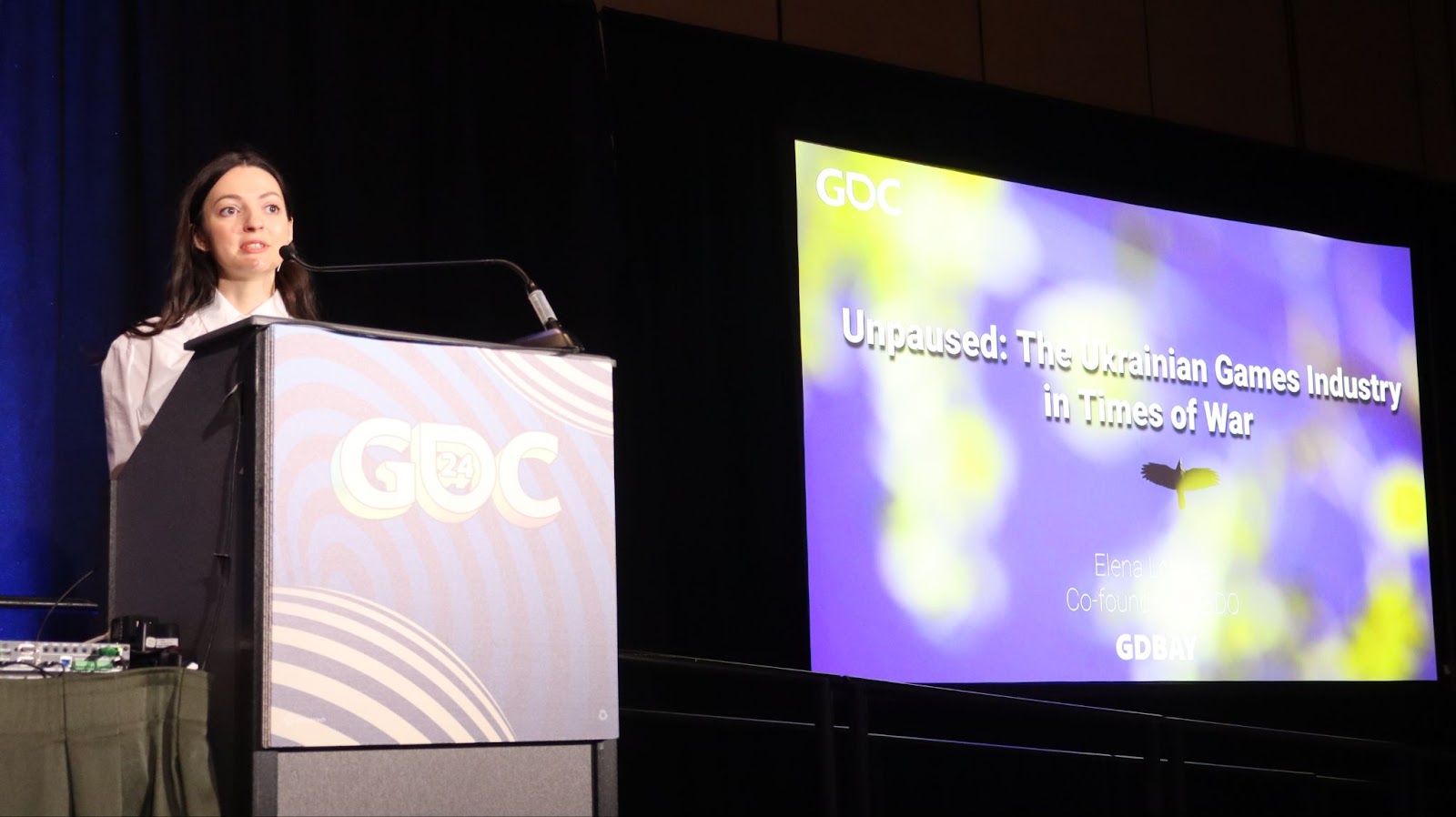
I was taken aback by the story of a game developer on the front lines who would work on his game within tranches. I was stunned that game studios took advantage of bomb shelters so they could work uninterrupted and continue crafting the experiences they wanted to share with the world. I was inspired by the unity the war has sparked with the Ukrainian games industry and how that support has allowed them to flourish.
12:10 AM PST
After such an enlightening talk, I went over to the Moscone South building as the Expo hall was open for the first time! The expo hall is a massive space where hundreds of exhibitors showcase their games, projects, programs, and services in a variety of creative installations. On one side of the Expo Hall, there were corporations like Unreal Engine and Epic Games, hosting a keynote speech on the functionalities of their game engine on a massive projector.
On the other side were exhibits like the New York State Booth which had a cozy little section for people to play games from the NYU Game Center and neighboring schools like RIT. Of course, I had to be there to support my classmates and represent the NYU Game Center on the opening day of the Expo Hall.

1:30 PM PST
The Women in Gaming International networking events threw me for a loop in all the right ways. Where I was expecting a quaint conference room with a handful of new people to meet, I instead got a barcade packed with talented women in games, myself included. We were given complimentary arcade cards and were free to network while playing games which is exactly what I did.

Over chicken sliders and small servings of garlic fries, I talked to people about their roles as producers and the state of the games industry. Between rotating games of Step-ManiaX, we talked about what we did in the games industry and had lighthearted discussions about the problems present in the mobile game development scene.

5:00 PM PST
Coming down from the intensity of the WIGI event, I decided to opt for a more serious yet relaxed discussion about women CEOs in the games industry back at the Moscone Center. Seeing Mitu Khandaker leading the roundtable discussion, one of my professors at the NYU Game Center who I saw the other day, reminded me how small this industry is.

The entire conversation was engaging. I witnessed a panel of CEOs in the gaming world talk about establishing boundaries so your empathy isn’t taken advantage of and you have a focus set on leading (rather than being a psychologist to your team). They talked about the importance of embracing failure and immediately taking the steps to work on being better and learning from your mistakes and mishaps. Women are often held to a higher standard in positions of power so their actions and the decisions they make are under higher scrutiny. They also talked about managing vulnerability to appear ‘human’ to your colleagues as a CEO and managing that vulnerability so it isn’t misconstrued as a weakness.
Women CEOs need to be aware of their tonality, the clarity of what they are talking about, and the transparency of the emotions they are feeling. Communication is the most important aspect of being a CEO in the games industry as a woman. I hung onto every word spoken during that panel, and I feel a little more prepared for what I may encounter as I work toward a leadership position in the games industry.
Senior Intern Kimari Rennis, who has been with the NYVGCC for many years, is a senior at the NYU Game Center.
Over 95% of the reviews and essays on NYGameCritics.com are created by our paid student interns and young mentors who have taken our classes. Donations help support our incredible student writers.


